Everyone has feelings, so everyone can be on the path of feelings. The same is true for thinking, acting, and being. So, the vision of Yoga is simply that Unity is possible for anyone, starting from wherever you happen to be. Unity is secretly present in every moment in daily life. Nothing can happen to me that is outside the one reality., nothing is wasted or random in the Cosmic design.
In the Vedic tradition, each person can choose four paths that arise from feeling, thinking, acting, and being. Each path is called a Yoga, the Sanskrit word for "union," because Unity - merging with one reality - was the goal.
Over the ages, the four Yogas have come to define specific paths that suit the kind of temperament a seeker has, although in truth you can follow several or all at once:
Bhakti Yoga., leads to Unity by loving God. Karma Yoga., leads to Unity through selfless action. Gyana Yoga., leads to Unity through Knowledge. Raj Yoga., leads to Unity through meditation and renunciation.
It's not necessary to think of the four paths as being Eastern. These Yogas were the original seeds, the means that brought Unity within reach. Literally translated, the fourth path, Raj Yoga, means "the royal way to union." What makes it royal is a belief that meditation transcends the other three paths. But the fourth path is also inclusive: By following it you are actually following all four at once. Your meditations go directly to the essence of your being. That essence is what love of God, selfless action, and Knowledge are trying to teach.
Adapted from The Book of Secrets, by Deepak Chopra (Harmony Books, 2004).

Thursday, December 1, 2011

Saturday, September 24, 2011
Aromatherapy & Essential Oils
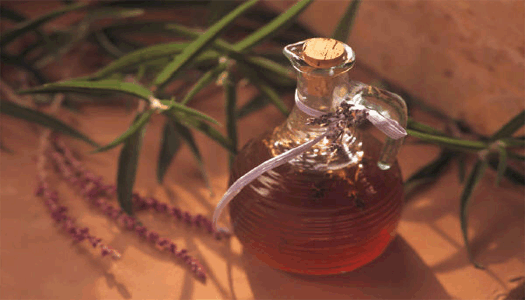
Definitions of Aromatherapy
Aromatherapy is the inhalation and application of essential oils to restore or enhance health, beauty and well being. This holistic treatment can help you to relax, rejuvenate or energize your body, calm your mind and lift your spirit.
The term "aromatherapie" was coined by the French chemist, Rene Maurice Gattefosse in 1928. He was convinced that the essential oils had antiseptic properties and other important healing abilities. While conducting an experiment in distillation he burned his hand and needing to cool it down, put his entire hand into a vat of pure lavender essential oil. The pain was gone almost instantly. Over the next few days his burn healed with no blisters, scars or infections. Thereafter he continued his research of this incredible phenomenon and uses of essential oils for other possible medical uses.
History of Aromatherapy
Combinations of resins, oils and fragrant plants were used in some form - for ceremonial, medicinal, or pleasurable reasons - in most ancient civilizations. In fact, perfumes and aromatic plants were the basis for many of the early trade routes. Some of the earliest documented uses of aromatherapy were in ancient Egypt. There, 3000 year old papyruses have been discovered containing remedies for many types of illnesses; some of the methods of application are similar to the ones used in aromatherapy today. The ancient Egyptians used aromatic plants and their essential oils to create massage oils, medicines, embalming preparations, skin care products, fragrant perfumes and cosmetics. There are other written accounts of aromatic oil use in ancient Africa, Mesopotamia, Greece, Babylon, India and China.
What are Aromatherapy Essential Oils?
Essential Oils are highly concentrated and potent oils extracted from plants, leaves, flowers, fruit, bark and roots by distillation with either water or steam, by mechanical processing of citrus rinds, or by dry distillation of natural materials. It takes at least one pound of any given plant to create one drop of pure essential oil and are most expensive. Synthetic fragrance oils have little or no therapeutic effect and are often mixed with petrochemicals.
How do Aromatherapy Essential Oils work?
Inhalation of Essential Oils - The effects of essential oils can be felt simply by breathing in the aromatic vapor. Smell triggers psychological and physiological responses in the body. Smell receptor cells transmit impulses about the smell to the olfactory area of the brain in the limbic system, which is linked, to memory, emotions, hormones, sexuality and heart rate. These impulses trigger neurochemicals and endorphins that can bring about a mental and a physical change.
Absorption of Essential Oils through the Skin - The second way for essential oils to penetrate the body is through the skin. Essential oils can stimulate circulation, encourage cell regeneration and the formation of new skin cells. Some essential oils calm inflamed or irritated skin, release muscle spasms, and relieve muscular tension. The positive effect of essential oils on blood circulation is well known. Studies have found that basil, tea tree and thyme essential oils can encourage the production of white blood cells and boosting the immune system of the body.
Interesting Facts
It takes 6,000 pounds of jasmine pedals to produce one pound of jasmine essential oil. In addition, jasmine can only be picked 3 months out of the year between 2 a.m. and 5 a.m. It takes 4,000 pounds of rose pedals to produce 1 pound of rose essential oil. Roughly translated that means it takes about 30 roses to produce 1 drop of essential oil.
Gather Us In

Gather us in, Thou Love that fillest all;
Gather our rival faiths within Thy fold;
Rend each man’s temple veil, and bid it fall,
That we may know that Thou hast been of old.
Gather us in—we worship only Thee;
In varied names we stretch a common hand;
In diverse forms a common soul we see;
In many ships we seek one spirit land.
Thine is the mystic life great India craves;
Thine is the Parsee’s sin-destroying beam;
Thine is the Buddhist’s rest from tossing waves;
Thine is the empire of vast China’s dream.
Thine is the Roman’s strength without his pride;
Thine is the Greek’s glad world without its graves;
Thine is Judea’s law with love beside,
The truth that censures and the grace that saves.
Some seek a Father in the heav’ns above;
Some ask a human image to adore;
Some crave a spirit vast as life and love;
Within Thy mansions we have all and more.
Thursday, August 25, 2011
The Healing Power of Salt

Although you may not realize it, simple table salt has a great number of uses other than simply seasoning your food. The following list will give you many uses of salt. Many of which you probably did not realize.
Soak stained clothing or material in salt water before washing.
Sprinkle salt on your shelves to keep ants away.
Add salt to green salads to prevent wilting.
Soak wrinkled apples in a mildly salted water solution to perk them up.
Soak toothbrushes in salt water before you first use them., they will last longer.
Boil clothespins in salt water before using them. They will last longer.
Clean brass, copper and pewter with paste made of salt and vinegar, thickened with flour.
Add a little salt to the water when you cut flowers. They will stand in for a longer life.
Pour a mound of salt on an ink spot on your carpet., let the salt soak up the stain.
Clean your iron by rubbing some salt on a damp cloth on the ironing surface.
Adding a little salt to water when cooking foods in a double boiler will make the food cook faster.
Use a mixture of salt and lemon juice to clean piano keys.
To fill plaster holes in your walls, use equal parts of salt and starch, with just enough water to make a stiff putty.
Rinse a sore eye with a little salt water.
Mildly salted water makes an effective mouthwash. Use it hot for a sore throat gargle.
Dry salt sprinkled on your toothbrush makes a good tooth polisher.
Use salt for killing weeds in your lawn.
Eliminate excess suds in your laundry wash with a sprinkle of salt.
A dash of salt enhances the taste of tea., whether brewing hot or chilled.
Rub any wicker furniture you may have with salt water to prevent yellowing.
Freshen sponges by soaking them in salt water.
Gelatin sets more quickly when a dash of salt is added.
Fruits put in mildly salted water after peeling will not discolor.
Add a pinch of salt to whipped cream to make it whip more quickly.
Remove leftover odors from cooking in the oven and on the stovetop by using a solution rinse of salt and cinnamon.
Salt and lemon juice removes mildew.
Sprinkle salt between sidewalk bricks where you don't want grass to grow.
Remove rusty odors from sink drainpipes with a strong, hot solution of salt and water.
If a pie bubbles over in your oven, put a handful of salt on top of the spilled juice. The mess won't smell and will bake into a dry, light crust which will wipe off easily when the oven has cooled off.
~ Robin Ann
Tuesday, August 23, 2011
Wisdom Emotion

Take with you words, strong words of courage.,
Words that have wings!..
Take with you words, words that know you.,
Words that are sacred as healing waters,
Pure as Light, and beautiful as morning,
Take with you tall words, words that reach up,
And growing words, with deep life within them.
Take with you words, words that know you.
There is nothing I can give you which you have not,
but there is much that while I cannot give you,
you can take:
No heaven can come to us unless our hearts find
rest in today. Take Heaven.
No peace lies in the future which is not hidden
in this present instant. Take Peace.
The gloom of the world is but a shadow.,
behind it, yet within reach, is joy. Take Joy.
We search the world for truth, we cull
The good, the true, the beautiful,
From graven stone and written scroll,
And all old flower-fields of the soul.,
And, weary seekers of the best,
We come back laden from our quest,
To find that all the sages said
Is in the book our mothers read.
* What lies behind us and what lies before us..
are tiny matters compared to what lies within us. *
*NOTE*
~ All phrases, quotes and poetic emotion are the works of others, but their names need not apply simply because that is not the point in sharing at this moment., it is the messages within them that matters the most. I would never take credit for any of them although I would be lying if I said I was not inspired by them. Which I am very much so inspired by each and every one for individual reasons. ~
Blessings all and always keep safe
Love, Courage, Peace xo
~ Robin Ann @,~>
Sunday, August 21, 2011
Poetry Emotion

The Wind
e.e.cummings
the wind is a Lady
with bright slender eyes
who moves at sunset
and who - touches the hills
with any reason
i have spoken with this
indubitable and green person
"Are You the wind?"
"Yes"
"Why do you touch flowers
as if they were unalive,
as if They were ideas?"
"because, sir things which
in my mind blossom
will stumble beneath
a clumsiest disguise, appear
capable of fragility and indecision
- do not suppose these without any reason
and otherwise roses and mountains
different from the i am who wanders
imminently across the renewed world"
"to me," said the wind "being a Lady
in a green dress, who
touches the fields
at sunset"
Saturday, May 21, 2011
The Parable of The Rock

Once there was a Rock, filled with countless atoms, protons, neutrons, and subatomic particles of matter. These particles were racing around continually, in a pattern, each particle going from "here" to "there", and taking "time" to do so, yet going so fast that the Rock itself seemed to move not at all. It just was. There it lay, drinking in the Sun, soaking up the rain, and moving not at all.
"What is this inside of me, that is moving?" the Rock asked.
"It is You," said a Voice from afar.
"Me?" replied the Rock. "Why, that is impossible. I am not moving at all. Anyone can see that."
"Yes, from a distance," the Voice agreed. "From way over here you do look as if you are solid, still, not moving. But when I come closer - when I look very closely at what is actually is happening - I see that everything that comprises what you are is moving. It is moving at incredible speed through "time and space" in a particular pattern which creates You as the thing called "Rock". And so, you are magic! You are moving and not moving at the same time."
"But," continued the Rock, asking, "which, then, is the illusion? The oneness, the stillness, of the Rock, or the separateness and the movements of its parts?"
To which the Voice replied, "Which, then, is the illusion? The oneness, the stillness, of Light, or the separateness and movements of its parts?"
Upon this Rock, for this is the Rock of Ages. This is the eternal Truth that leaves no stone unturned. This is the Cosmology.
Monday, April 11, 2011
Time To Spread The Wings
 Spring is finally here and in the Garden State as birders on a long winter hiatus from their favorite warm weather pastime, are now taking their binoculars out of storage. The thought of warblers in breeding plumage and the beauty of their favorite bird songs are dancing in their heads, fostering a need to get out into the field, ASAP. ~~~~~~~~~~~~~~~~~~~~~~~~~~~~~~~~~~~~~~~~~~~~~~~~~~~~~~~~~~~~~~ ~~~~~~~~~~~~~~~~~~~ Birding can still be slow now as birds begin to trickle in with migration in earnest not occurring for another few weeks or so. Early warblers such as palm, pine, yellow-throated and Louisiana waterthrush have already arrived with black-and-white, northern parula and yellow not far behind. The ubiquitous yellow-rumped warblers that have been around all winter in their drab attire are now looking quite spiffy in their breeding plumage. The vanguard of the remaining New Jersey arriving warblers will take place before month's end with the exception of Cape May, bay-breasted and mourning warblers, all strictly migrants that arrive here in May. ~~~~~~~~~~~~~~~~~~~~~~~~~~~~~~~~~~~~~~~~~~~~~~~~~~~~~~~~~~~~~~ ~~~~~~~~~~~~~~~~~~~ Two excellent locations in your search for warblers this spring are Sandy Hook and Garret Mountain Reservation in Woodland Park, with Belleplain State Forest in Cape May County, a great place to drive south to meet spring in late April. Belleplain has nesting yellow-throated, prairie, prothonotary, worm-eating, Kentucky (occassionally) and hooded warblers as well as summer tanager, a difficult bird to find in North Jersey. Nearby Jakes Landing can offer great marsh birding to cap a great day in the field. ******************************************************************************* ******* What's Been Seen * ~ * ~ * ~ * ~ * ~ * ~ * ~ * ~ * ~ * ~ * ~ * ~ * ~ * ~ * ~ * ~ * ~ * ~ * ~ * ~ * ~ * ~ * ~ * ~ * ~ * ~ ~ * ~ * ~ * ~ * ~ * ~ * ~ * ~ * ~ * ~ * ~ * ~ * ~ * ~ * ~ * ~ * ~ * ~ * ~ * ~ * ~ * ~ * ~ * ~ * ~ * ~ * Here are some sightings from the New Jersey Audubon Society's weekly "Voice of New Jersey Audubon" rare bird alert (732-872-2595): ~ ~ ~ ~ ~ ~ ~ ~ ~ ~ ~ ~ ~ ~ ~ ~ ~ ~ ~ ~ ~ ~ ~ ~ ~ ~ ~ ~ ~ ~ ~ ~ ~ ~ ~ ~ ~ ~ ~ ~ ~ ~ ~ ~ ~
 *Sandhill crane, Sandy Hook
*Red-headed woodpecker, Clark
*Yellow-headed blackbird, Sandy Hook
*Eurasian wigeon, Kittatinny State Park
*Louisiana waterthrush, Garret Mountain Reservation, Woodland Park
*Short-eared owl, Forsythe (Brigantine) National Wildlife Refuge
*Black-headed gull, Bayonne
*Glaugous gull, South Amboy
*Cliff swallow, Sandy Hook
*Caspian tern, Forsythe (Brigantine) National Wildlife Refuge
~*~*~*~*~*~*~*~*~*~*~*~*~*~*~*~*~*~*~*~*~*~*~*~*~*~*~*~*~*~*~*~*~*~*~*~*~*~ *~*~*~*~*~*~*~ On The Lookout
The Sandy Hook Bird Observatory will sponsor these birding field trips:
*April 17: Garret Mountain Reservation, Woodland Park
*April 17: Sandy Hook Beginning Birders, free
*April 30: Belleplain State Forest
There is a fee for these events, unless otherwise noted. For more information or to register, call the Sandy Hook Bird Observatory at: (732) 872-2500
This article post was written by Pete Bacinski and Scott Barnes of the New Jersey Audubon Society's Sandy Hook Bird Observatory. Questions or comments should be directed to them at (732) 872-2500. or shbo@njaudubon.org
Friday, April 8, 2011
Love Is a Natural Emotion

by Neale Donald Walsch
Love is a Natural Emotion. When it is allowed to be expressed, and received, by a child, normally and naturally, without limitation or condition, inhibition or embarrassment, it does not require anything more. For the joy of love expressed and received in this way is sufficient unto itself. Yet love which has been conditioned, limited, warped by rules and regulations, rituals and restrictions, controlled, manipulated, and withheld, becomes unnatural. Children who are made to feel that their natural love is not okay--that it is wrong to express it, and that, in fact, they shouldn't even experience it--will have a difficult time appropriately dealing with love as adults. Love that is continually repressed becomes possessiveness, a very unnatural emotion. People have killed because of possessiveness. Wars have started, nations have fallen.
~~~~~~~~~~~~~~~~~~~~~~~~~~~~~~~~~~~~~~~~~~~~~~~~~~~~~~~~~~~~~~~~~~~
People love to be in love. Yet "love" is a big word. It is the biggest word in the language. Any language. What is love, really? Conversations with God has a lot to say on this subject. Among other things, it says that love is a decision, not a reaction. That may be one of the most important things anyone could ever say on the subject. True love is never the result of how another person looks, behaves, or interacts with us. It is a choice to be loving no matter how that other looks, behaves or interacts with us. This does not mean that true love requires us to stay in a relationship that is abusive.
~~~~~~~~~~~~~~~~~~~~~~~~~~~~~~~~~~~~~~~~~~~~~~~~~~~~~~~~~~~~~~~~~~~
Do not confuse the words "love" and "relationship." We are not proving that we love someone by staying in a relationship. Indeed, there are instances when we may be proving we love them by leaving. So it is not true that love demands that we accept abuse from the one that we love. If a person is abusive to us, it is abusive to that person to allow their abuse to continue. For if we allow their abuse to continue, what do we teach them? Yet if we make it clear that the abuse in unacceptable, what then have they learned? Of course, it is true that no one can ever really "get out" of a relationship. We are always in relationship with each other, and the only thing that changes is the form the relationship takes. You cannot end a relationship, you can only change it. So do not think in terms of ending your relationship, think in terms of changing it. You may wish to change its form, or you may wish to hold onto the form, but change its characteristics within that form. Choosing to love someone --- truly love them --- is a very high act. It is the mark of a Master.
~~~~~~~~~~~~~~~~~~~~~~~~~~~~~~~~~~~~~~~~~~~~~~~~~~~~~~~~~~~~~~~~~~~
Loving someone as a "reaction" is a somewhat less elevated experience. It is the mark of a student. The danger of loving someone as a reaction is that the one we love may change. In fact, it is a certainty that they will. They may gain weight, or lose it. They may alter their personality. They may change their ideas about something important to us. And if we are in love with what others bring to us in relationship, we could be headed for enormous disappointment. So we come to the second big truth about all this: love is not about what the other brings to you, it is about what you bring to the other. Indeed, the purpose of all love relationships is to provide us with an opportunity to decide and to declare, to be and to express, to become and to fulfill, Who We Really Are. This is perhaps another way of restating the first truth, because Who We Really Are is a choice, not a response. It is a decision, not a reaction - although it is true that most people think it is the other way around. When I talk to young people about love, I tell them that there are two questions having to do with life and relationship that everyone would benefit from asking. 1. Where am I going? 2. Who is going with me?
~~~~~~~~~~~~~~~~~~~~~~~~~~~~~~~~~~~~~~~~~~~~~~~~~~~~~~~~~~~~~~~~~~~
It is important to ask these in the right order. Many people switch them around --- and suffer for it the rest of their lives. First they ask, who is going with me in my life? Then they ask, where am I going? Often, the choice of destination is conditioned and compromised by the choice of companion. This can make for a very rough journey. I remember how at one of our spiritual renewal retreats (we have one coming up in July, called The Conversation School--a 7-day event with only 18 participants ) one young woman in her twenties asked sadly, "What does it feel like to be in love?" I told her I could not answer for anyone else, but I know what it feels like to me. It feels like there is only one of us in the room. When I am with my beloved other, Em, it feels as if there is no place where "I" end and "she" begins. When I look into Em's eyes, it is like looking into my own. When I sense that Em is sad, it is as if the sadness pierces my own heart. When she smiles, the heart of me smiles with her --- as her. I wish I could feel this way about everyone. That is what I am working toward. I am feeling it with more and more people very day.
~~~~~~~~~~~~~~~~~~~~~~~~~~~~~~~~~~~~~~~~~~~~~~~~~~~~~~~~~~~~~~~~~~~
A Course in Miracles says, "No special relationships." In other words, no one person should be more special to us than another. That is how God experiences love. There is no condition, and no one is more special than another. It is difficult for most people to understand that. How can God love us all equally, the "good" and the "bad" alike? It is because God does not see any of us as "good" or "bad." We are all perfect in God's eyes, no matter how we are behaving. Human beings have a long way to go before they can claim that. Most of us place condition after condition on our love, and we are very fast to withdraw it when those conditions are not met.
~~~~~~~~~~~~~~~~~~~~~~~~~~~~~~~~~~~~~~~~~~~~~~~~~~~~~~~~~~~~~~~~~~~
So the third great truth about love is that it knows no conditions. There is no such thing as "I love you IF..." in God's world. The fourth great truth about love is that it knows no limitations. Love is freedom, experienced. Total and absolute freedom. And so one who loves another never seeks to restrict or limit that other in any way. This is a tough one for many people. For many, love translates, roughly, into "ownership." Not that this is ever expressed, of course. It is simply felt. It is a felt sense of "you're mine." Of course, in true love nothing could be further from the truth. And in true love, such ideas or thoughts are never part of the paradigm. No one owns anyone, and no one acts as if they do. This has major implications, as one might imagine. So now I am going to list the fifth, and perhaps the most "controversial," truth about love that I know. Love never says no. Not to persons of equal maturity and intelligence. (We are not talking about children here. Let's limit this discussion to adults.) No matter what the request of the beloved, love says yes. This does not mean that personal opinions are not expressed, nor personal preferences announced. But, in the end, a request from the beloved is never denied. Again, that is difficult for many people to grapple with. Yet this is the way that God loves. I am fond of saying in my lectures and retreats that God has only one word in Her vocabulary. God always says yes. No matter what you want, no matter what you choose, He never says no. This idea can be reduced to two-words: God allows. Since Conversations with God teaches that the words "God" and "love" are interchangeable, you could then say, "love allows." In the end, that is what love does. Love allows. It never restricts, it never limits, it never stops, it only allows. In true love relationships, you get to have what you want.
~~~~~~~~~~~~~~~~~~~~~~~~~~~~~~~~~~~~~~~~~~~~~~~~~~~~~~~~~~~~~~~~~~~
The sixth truth about love is that it always renews itself. It never runs out. As a regular ritual in our marriage, Em and I exchange our wedding vows every year on our anniversary. We have a whole wedding ceremony, with a minister, invited guests, the dinner and cake...the whole nine yards. Now some of our married friends have told us that they love this idea and that they are now doing it on their anniversary! ;o) It's so rewarding when we see something like that happen!
It's as if Love Itself has multiplied Itself, with us as the instrument. And you, too, can be, equally, an instrument of Love's Multiplication. With every thought you think, with every word you speak, with every action you take. Love is a natural emotion. When we are allowed to express it fully in every day in every way, we come alive, through the direct experience of Who We Really Are.
~~~~~~~~~~~~~~~~~~~~~~~~~~~~~~~~~~~~~~~~~~~~~~~~~~~~~~~~~~~~~~~~~~~
© 2011 ReCreation Foundation - http://www.cwg.org - Neale Donald Walsch is a modern day spiritual messenger whose words continue to touch the world in profound ways. His With God series of books has been translated into 27 languages, touching millions of lives and inspiring important changes in their day-to-day lives.
Thursday, March 17, 2011
Meditation on the Heart
Adapted from The Path to Love, by Deepak Chopra (Three Rivers Press, 1997).
Read more: http://www.care2.com/greenliving/meditating-on-the-heart.html#ixzz1GseUOWAb
Sit comfortably in a quiet room by yourself, choosing a time when you feel settled and unhurried. Early morning is best, since your mind will be alert and fresh. Close your eyes and focus your attention on the middle of your chest, where your heart is. (The fact that the physical heart is off to the left is irrelevant here – the spiritual heart center lies directly behind your breastbone.)
Be aware of your heart as a space. Don’t try to hear your heartbeat or any other sound you think a heart makes as it pumps blood. The heart center you want to find is a point of awareness where feelings enter. In its pure form it is empty, pervaded by weightlessness, absence of care, peace, and a subtle light.
This light may appear as white, gold, pale pink, or blue. Don’t strain to find a light of any kind. You are not trying to sense the purity of the heart center right now; all you need to feel is whatever is there.
Letting your attention rest easily there, breathe gently and sense your breath going into your heart center. Here you may want to visualize a soft pastel light, or a coolness pervading the chest. Let the breath go in and out, and as it does, ask your heart to speak to you.
For the next five or ten minutes, sit and listen. Your heart will begin to release emotions, memories, wishes, fears, and dreams long stored there, and as it does, you will find yourself paying attention.
Let the experience be what it will be. If you daydream or drift off into sleep, just bring your attention back to your heart center. You will notice as you continue this exercise that three things are naturally coming together: meditation, purification, and attention.
You are learning to be with your heart in order to heed its spiritual meaning – this is meditation. You are letting repressed material come up to be released – this is purification. You are listening to your heart without judgment or manipulation – this is attention.
Read more: http://www.care2.com/greenliving/meditating-on-the-heart.html#ixzz1GseUOWAb
Sit comfortably in a quiet room by yourself, choosing a time when you feel settled and unhurried. Early morning is best, since your mind will be alert and fresh. Close your eyes and focus your attention on the middle of your chest, where your heart is. (The fact that the physical heart is off to the left is irrelevant here – the spiritual heart center lies directly behind your breastbone.)
Be aware of your heart as a space. Don’t try to hear your heartbeat or any other sound you think a heart makes as it pumps blood. The heart center you want to find is a point of awareness where feelings enter. In its pure form it is empty, pervaded by weightlessness, absence of care, peace, and a subtle light.
This light may appear as white, gold, pale pink, or blue. Don’t strain to find a light of any kind. You are not trying to sense the purity of the heart center right now; all you need to feel is whatever is there.
Letting your attention rest easily there, breathe gently and sense your breath going into your heart center. Here you may want to visualize a soft pastel light, or a coolness pervading the chest. Let the breath go in and out, and as it does, ask your heart to speak to you.
For the next five or ten minutes, sit and listen. Your heart will begin to release emotions, memories, wishes, fears, and dreams long stored there, and as it does, you will find yourself paying attention.
Let the experience be what it will be. If you daydream or drift off into sleep, just bring your attention back to your heart center. You will notice as you continue this exercise that three things are naturally coming together: meditation, purification, and attention.
You are learning to be with your heart in order to heed its spiritual meaning – this is meditation. You are letting repressed material come up to be released – this is purification. You are listening to your heart without judgment or manipulation – this is attention.
Monday, March 1, 2010
Herbalism As a Method of Medicine
The use of plants for healing is by far the world’s oldest and most widely known therapy. Since the beginning of time, the knowledge of herbal remedies has been handed down from generation to generation. With the growth of synthetic drug manufacturing, however, the direct use of medicinal plants for a time, became a thing of the past.
It is only recently that there has been an increase in interest in herbalism as a method of medicine that is safe, natural, and cheap.The purpose of herbal remedies is to stimulate the body’s own natural healing abilities by cleansing and rebalancing. Like the synthetic drugs, many herbs contain antibacterial and antiviral properties. The advantage of herbal remedies is their ability to rapidly return the body to a state of health without the damaging side effects; unlike synthetic drugs.
Herbs, correctly prescribed, can be combined to target, regulate, heal or tone any organ in the body, unless the tissue has been completely destroyed.The earliest known records of medicinal herbs date back to 3,000 BC, from northern China. The herbs identified in those records; such as, myrrh and frankincense, are still being used today. At that time, however, herbalism was often explained in terms of astrology and folklore.
From the 16th century on, the division between herbalism and allopathic medicine grew further and further apart. By the 19th century, published knowledge of herbalism had increased through advances in scientific botany, and a number of North American Indian herbal remedies had been added to the pharmacopoeia, the list of medicinal drugs. However, herbal cures were out of fashion.Pre-packaged medicines used in orthodox medical practice are in fact extracted from traditional medicinal herbs; such as digitalis and aspirin. Research establishments have confirmed the value of the traditional uses of whole herbs.
A qualified medical herbalist combines a sophisticated understanding of the human body with the knowledge of herbal pharmacopoeia. They are trained to search out the root cause of ailments and symptoms. Diarrhea, for example, may have many possible causes; among them, a viral infection, nervous stress, diet, or even contaminated water.
Although many herbs will correct the symptoms, it takes an experienced practitioner to identify the cause. For this reason it is wise to consult a professional, even if you have read about the effects of a remedy and matched it to an ailment.
Herbal nutrition is all about managing, protecting, perfecting, and preventing health concerns with natural healing herbs.
It is only recently that there has been an increase in interest in herbalism as a method of medicine that is safe, natural, and cheap.The purpose of herbal remedies is to stimulate the body’s own natural healing abilities by cleansing and rebalancing. Like the synthetic drugs, many herbs contain antibacterial and antiviral properties. The advantage of herbal remedies is their ability to rapidly return the body to a state of health without the damaging side effects; unlike synthetic drugs.
Herbs, correctly prescribed, can be combined to target, regulate, heal or tone any organ in the body, unless the tissue has been completely destroyed.The earliest known records of medicinal herbs date back to 3,000 BC, from northern China. The herbs identified in those records; such as, myrrh and frankincense, are still being used today. At that time, however, herbalism was often explained in terms of astrology and folklore.
From the 16th century on, the division between herbalism and allopathic medicine grew further and further apart. By the 19th century, published knowledge of herbalism had increased through advances in scientific botany, and a number of North American Indian herbal remedies had been added to the pharmacopoeia, the list of medicinal drugs. However, herbal cures were out of fashion.Pre-packaged medicines used in orthodox medical practice are in fact extracted from traditional medicinal herbs; such as digitalis and aspirin. Research establishments have confirmed the value of the traditional uses of whole herbs.
A qualified medical herbalist combines a sophisticated understanding of the human body with the knowledge of herbal pharmacopoeia. They are trained to search out the root cause of ailments and symptoms. Diarrhea, for example, may have many possible causes; among them, a viral infection, nervous stress, diet, or even contaminated water.
Although many herbs will correct the symptoms, it takes an experienced practitioner to identify the cause. For this reason it is wise to consult a professional, even if you have read about the effects of a remedy and matched it to an ailment.
Herbal nutrition is all about managing, protecting, perfecting, and preventing health concerns with natural healing herbs.
Tuesday, February 16, 2010
Know Your Nutrients in Herbs
We know herbs are used to flavor our foods and used to treat mild to severe illnesses. Have you ever considered the fact that herbs also provide nutrition to the body? Herbs do provide important vitamins and minerals but yet this wonderful fact is overlooked.
I have listed below some of the nutrients found in herbs. Keep your eyes open for herbs that appear in more than one listing such as alfalfa, dandelion. This tells you what a powerhouse these plants are. Many herbs have several minerals and vitamins.
Listed here are Vitamins A and B.
Vitamin A:
This helps to prevent skin diseases, night blindness and even skin cancer because it acts as an antioxidant. It also helps to repair mucus membrane cells and skin cells. It helps the body to use protein and slow down the aging process.
Herbs with Vitamin A:
Alfalfa, Black Cohosh, Borage, Burdock Root, Cayenne, Chickweed, Comfrey, Dandelion, Echinacea, Elder, Eyebright, Fennel, Goldenseal, Hops, Kelp, Lemongrass, Nettle, Oat Straw, Paprika, Parsley, Peppermint, Plantian, Raspberry Leaf, Red Clover and Rose Hips.
Vitamin B1:
This is also known as Thiamine which supports healthy circulation, helps with carb. metabolism and helps to create stomach aids such as Hydrochloric Acid. Any time you see "helps with carb. metabolism" that is a key to weight loss.
Herbs with Vitamin B1:
Alfalfa, Bladderwrack, Burdock Root, Catnip, Cayenne, Chamomile, Chickweed, Dandelion, Fenugreek, Hops, Nettle , Red Clover, Sage and Yarrow.
Vitamin B2:
This is known as Riboflavin and plays an important part of antibody and red cell formation. It also aids in the metabolism of carbs, fats and proteins. Consuming enough Riboflavin can prevent cataracts and birth defects.
Herbs with Vitamin B2:
Alfalfa, Bladderwrack, Burdock Root, Catnip, Cayenne, Chamomile, Chickweed, Dandelion, Eyebright, Fennel, Fenugreek, Ginseng, Hops, Nettle, Oat Straw, Parsley, Peppermint, Raspberry Leaf, Red Clover, Rose Hips and Sage.
Vitamin B3:
Vitamin B3 or Niacin is needed to support healthy circulation and skin, and again this nutrient helps with breaking down carbs, fats and protein. The B Vitamins are very helpful in regulating the metabolism. This also helps with memory and mental illnesses such as schizophrenia.
Herbs with Vitamin B3:
Alfalfa, Blue Cohosh, Burdock Root, Catnip, Cayenne, Chamomile, Chickweed, Eyebright, Fennel, Ginger, Hops, Licorice, Mullein, Nettle, Oat Straw, Parsley, Peppermint, Raspberry Leaf, Red Clover and Slippery Elm.
Vitamin B5:
This is required by all the cells of the body and is known as Pantothenic Acid. It helps with proper nerve function and is called the "anti-stress Vitamin" again like most of the B Vitamins this one also helps with metabolism.
Herbs with Vitamin B5:
Black Cohosh, Catnip, Eyebright and Red clover.
Vitamin B6:
Pyridoxine is a very important nutrient. It helps to retrack the formation of homocysteine, a toxic chemical which attacks the heart muscle and causes cholesterol deposits around the heart. A lack of Vitamin B6 has been found to be a contributing factor to Carpal Tunnel Syndrome. This Vitamin also helps to maintain the potassium and sodium balance.
Herbs with Vitamin B6:
Alfalfa, Catnip, Oat Straw, Hawthorn Berries and Licorice.
Vitamin B12:
This is needed to combat Anemia, by helping to create red blood cells and utilizing Iron. It also helps to protect nerve endings and is linked to the production of Acetylcholine a neurotransmitter that assist in memory. Alzheimer's victims have a lower amount of this neurotransmitter.
Herbs with Vitamin B12:
Alfalfa, Bladderwrack, Dandelion, Hawthorn Berries, Hops, Mullien and White Oak Bark.
I have listed below some of the nutrients found in herbs. Keep your eyes open for herbs that appear in more than one listing such as alfalfa, dandelion. This tells you what a powerhouse these plants are. Many herbs have several minerals and vitamins.
Listed here are Vitamins A and B.
Vitamin A:
This helps to prevent skin diseases, night blindness and even skin cancer because it acts as an antioxidant. It also helps to repair mucus membrane cells and skin cells. It helps the body to use protein and slow down the aging process.
Herbs with Vitamin A:
Alfalfa, Black Cohosh, Borage, Burdock Root, Cayenne, Chickweed, Comfrey, Dandelion, Echinacea, Elder, Eyebright, Fennel, Goldenseal, Hops, Kelp, Lemongrass, Nettle, Oat Straw, Paprika, Parsley, Peppermint, Plantian, Raspberry Leaf, Red Clover and Rose Hips.
Vitamin B1:
This is also known as Thiamine which supports healthy circulation, helps with carb. metabolism and helps to create stomach aids such as Hydrochloric Acid. Any time you see "helps with carb. metabolism" that is a key to weight loss.
Herbs with Vitamin B1:
Alfalfa, Bladderwrack, Burdock Root, Catnip, Cayenne, Chamomile, Chickweed, Dandelion, Fenugreek, Hops, Nettle , Red Clover, Sage and Yarrow.
Vitamin B2:
This is known as Riboflavin and plays an important part of antibody and red cell formation. It also aids in the metabolism of carbs, fats and proteins. Consuming enough Riboflavin can prevent cataracts and birth defects.
Herbs with Vitamin B2:
Alfalfa, Bladderwrack, Burdock Root, Catnip, Cayenne, Chamomile, Chickweed, Dandelion, Eyebright, Fennel, Fenugreek, Ginseng, Hops, Nettle, Oat Straw, Parsley, Peppermint, Raspberry Leaf, Red Clover, Rose Hips and Sage.
Vitamin B3:
Vitamin B3 or Niacin is needed to support healthy circulation and skin, and again this nutrient helps with breaking down carbs, fats and protein. The B Vitamins are very helpful in regulating the metabolism. This also helps with memory and mental illnesses such as schizophrenia.
Herbs with Vitamin B3:
Alfalfa, Blue Cohosh, Burdock Root, Catnip, Cayenne, Chamomile, Chickweed, Eyebright, Fennel, Ginger, Hops, Licorice, Mullein, Nettle, Oat Straw, Parsley, Peppermint, Raspberry Leaf, Red Clover and Slippery Elm.
Vitamin B5:
This is required by all the cells of the body and is known as Pantothenic Acid. It helps with proper nerve function and is called the "anti-stress Vitamin" again like most of the B Vitamins this one also helps with metabolism.
Herbs with Vitamin B5:
Black Cohosh, Catnip, Eyebright and Red clover.
Vitamin B6:
Pyridoxine is a very important nutrient. It helps to retrack the formation of homocysteine, a toxic chemical which attacks the heart muscle and causes cholesterol deposits around the heart. A lack of Vitamin B6 has been found to be a contributing factor to Carpal Tunnel Syndrome. This Vitamin also helps to maintain the potassium and sodium balance.
Herbs with Vitamin B6:
Alfalfa, Catnip, Oat Straw, Hawthorn Berries and Licorice.
Vitamin B12:
This is needed to combat Anemia, by helping to create red blood cells and utilizing Iron. It also helps to protect nerve endings and is linked to the production of Acetylcholine a neurotransmitter that assist in memory. Alzheimer's victims have a lower amount of this neurotransmitter.
Herbs with Vitamin B12:
Alfalfa, Bladderwrack, Dandelion, Hawthorn Berries, Hops, Mullien and White Oak Bark.
Monday, February 15, 2010
Wisdom Emotion
To find the universal elements enough; to find the air and the water exhilarating; to be refreshed by a morning walk or an evening saunter; to be thrilled by the stars at night; to be elated over a bird's nest or a wildflower in spring - these are some of the rewards of the simple life. ~ John Burroughs
Tuesday, November 24, 2009
Live a Life That Matters

Ready or not, someday it will all come to an end.
There will be no more sunrises, no minutes, hours or days.
All the things you collected,
whether treasured or forgotten, will pass to someone else.
Your wealth, fame and temporal power will shrivel to irrelevance.
It will not matter what you owned or what you were owed.
Your grudges, resentments, frustrations,
and jealousies will finally disappear.
So, too, your hopes, ambitions, plans, and to-do lists will expire.
The wins and losses that once seemed so important will fade away.
It won't matter where you came from,
or on what side of the tracks you lived, at the end.
It won't matter whether you were beautiful or brilliant.
Even your gender and skin color will be irrelevant.
So what will matter?
How will the value of your days be measured?
What will matter is not what you bought,
but what you built;
not what you have, but what you gave.
What will matter is not your success,
but your significance.
What will matter is not what you learned,
but what you taught.
What will matter is every act of integrity,
compassion, courage or sacrifice that enriched,
empowered or encouraged others to emulate your example.
What will matter is not your competence,
but your character.
What will matter is not how many people you knew,
but how many will feel a lasting loss when you're gone.
What will matter is not your memories,
but the memories that live in those who loved you.
What will matter is how long you will be remembered,
by whom and for what.
Living a life that matters doesn't happen by accident.
It's not a matter of circumstance but of choice.
Choose to live a life that matters.
Wednesday, November 4, 2009
Hearts Emotion
Bricks In The Wall
If words could say it all
There would be no reason to touch
If a touch could say it all
There would be no reason to feel
Maybe we would never know
The endless possibilities
If a word our touch
Could say it all
(c) Copyright 2009 Edward Randall Arriaga
A Cruise Down Main Street
The13thStranger
If words could say it all
There would be no reason to touch
If a touch could say it all
There would be no reason to feel
Maybe we would never know
The endless possibilities
If a word our touch
Could say it all
(c) Copyright 2009 Edward Randall Arriaga
A Cruise Down Main Street
The13thStranger


Saturday, October 24, 2009
Bring Autumn Indoors

There’s nothing more luscious than inviting nature indoors in the fall: The brilliant colors of autumn make our homes feel deliciously warm and cozy as the weather turns cooler. Changing leaves, swags of grapevine, and vibrantly-colored apples and squashes make gorgeous, inexpensive decorations.
Find out how to connect with the abundant bounty and beauty of this harvest season with these fun, easy tips for decorating with nature:
1. Preserve some colorful leaves.
You can iron them between sheets of waxed paper, microwave them for a few seconds, put them in a solution of glycerin, or press them between the pages of a heavy book. Then you can apply them to backsplashes, place them artfully in a vase, mound them around a pile of gourds or squashes, or even use them as coasters for your favorite beverages.
2. Food is art.
Find a local Farmer’s Market or roadside stand and load up on apples, pears, pumpkins, decorative squashes, nuts, gourds, and Native American corn. A simple wooden bowl loaded with these treasures makes an abundant centerpiece. You can parade them in a line on a mantel-piece or pile them in a basket. What you don’t eat, you can enjoy looking at.
3. Other treasures.
Bring in grapevines to twine along the countertops, or make wreaths for doors or cabinets. If you live in an area where bittersweet is not a protected plant, harvest some to put in an earthen vase. Corn shocks are traditional to stand beside a door, but broom corn makes a beautiful and less usual alternative with its graceful russet fronds.
4. Beeswax candles.
The amber color and honey-sweet aroma of these safe, all-natural candles just evoke the golden glow of autumn. As the days get shorter, it can be a soothing ritual to burn a beeswax candle at dusk.
5. Echo Fall colors.
Bring in the Autumn hues of russet-red, vibrant shades of orange, deep greens, mellow golds, wine-reds, and vivid scarlet with cushions, towels, scatter-rugs, or other decorative accents.
Find the simple treasures you will enjoy.
6. Try this creative and relaxing Leaf Meditation.
Find a perfect autumn leaf and spend some time really looking at it, noticing the variations in color and shape. Trace its outline on a piece of paper, then try your hand at coloring it in with colored pencils, markers, or paints. Slowing down and taking time to savor the beauty of something as simple and commonplace as a leaf opens our eyes and hearts to nature’s magical variety. You may want to cut your colored leaf out and glue it on the cover of a journal to keep you company throughout the autumn months. Or do several leaves to decorate your cabinets or walls!
7. Think water.
Western European traditions often associate Autumn with the element of water, since it is a time of deep feeling and flowing away: birds migrate, trees shed their leaves. Honor this ancient idea with a bowl of water in a special place. Notice how water evaporates. As you refill your bowl throughout the autumn months, give a little thought to your own feelings, and the things that you are in the process of releasing from your life.
Thursday, October 22, 2009
Helping Your Animal Shelters and Groups

Do you have a favorite animal rescue group or animal shelter?
Starting on November 5th you can help that group win $10,000 in an upcoming America's Favorite Animal Shelter contest! All your favorite shelter needs to do to be a part of the contest is to be listed with Adopt-a-Pet.com, North America's largest non-profit pet-adoption web service.
Over 8,000 animal shelters and rescue groups already post their pets on Adopt-a-Pet.com and those pets are seen by 900,000 adopters who visit the site each month.
The service is free for shelters and for pet adopters and saves hundreds of thousands of lives!
If you don't see your favorite shelter in the list, please contact them and have an authorized shelter representative go to http://www.care2.com/go/z/e/AFQ2r/zJxV/AKpCa to sign up.
You can also see an animated tour of Adopt-a-Pet.com features at http://www.adoptapet.com/tour.
If you see your group listed, then you're all set! Come back to our contest site on November 5th to vote.
Want to get started spreading the word for your favorite group?
Want to get started spreading the word for your favorite group?
Download a flyer and some web banners you can use to promote:
The Care2 Petition Site Team
Care2.com
Inc.275 Shoreline Drive
Suite 300
Redwood City, CA 94065
Sunday, October 18, 2009
In Sickness and In Health

Love is a choice you make from moment to moment.
~ Barbara De Angelis
If love is so healing why does it hurt so much? This is a good question with difficult answers. Love the verb is a constant practice of feeling compassion, giving the benefit of the doubt and struggling to feed our goals and desires, as well as those of whom we love. This aspiration is a juggle even in the most functional of relationships; and the score rarely comes up 50-50.
Approaching our intimate relationships with the intent of an action verb is realistic, if not a bit daunting. The romantic version of the verb, the measure we use for our love relationships, reflects the illusion of love as a vacation. We sit side by side in some beautiful natural location and the only action required is offered by the love that we feel, washing over us, filling us, just as easily as the nearby waterfall washes over and fills the streambed. Physical intimacy carries the potential to generate this experience; flush with heightened hormones and released tension; lovemaking seems to encompass all of what is love.
These peaks of love are profoundly healing and sustaining. However it is unrealistic to expect that these experiences should encompass all that is love. When we are unable to show up for those we love, the feelings that we bear are the polar opposite of what we feel when we succeed in these relationships. It doesn’t matter if the slight is intended or a consequence of life’s competing demands. Generating the love sometimes is our work alone. Giving up lesser priorities in the face of illness always seems so clear in retrospect, but not always easy to discern in the moment.
More often than not, there is no malice intended in most of love’s disappointments. Life frequently tests our ability to forgive the intrusions to our peace of mind and to sustain the pain and longing of someone we love and cannot show up for. We must be willing to balance the hardships, bear the ache in our heart and in our relationships if we expect to experience the vacation of love working for us. If we are unwilling to sustain the work of love, all we ever get is a brief glimpse of a paradise, fading fast enough that it is easy to dismiss.
Illness is as much a part of our human condition as is wellness. Most of what we do in life can be traced back to the basic human drive to be happy and well. The times that we feel most fragile are made more bearable when held in love. Unfortunately, the courage and intention to sustain each other during the daily annoyances is sadly often more than we can bear. The number of people who report feelings of relief at the end of their long-term relationships continues to amaze me. Loving each other is the hardest work we do and what we do with that work defines our life in health and illness. Although I feel bad about not being the mother I want to be, although I do what I can, as much as I can within my power to do. I hope that I return to work with more resolve to stay with it.
I may have shared this before, though I will yet again because it holds such a value in everything.
*Step out of the circle of time and into the circle of Love. ~ Love has no limit.
Blessings ~
Friday, October 16, 2009
Decorating Techniques
Mix & Match
Watch the placement of patterns:
Don't put two strong patterns right next to each other. If you're mixing frabrics on a sofa or chair, make sure there's neutral pattern between stronger designs.
Mix fabrics on pillows and chair cushions:
Put a different pattern on each side, and get a new look by simply flipping the pillows or cushions.
Pick materials you love:
If you like it, if it looks nice to your eye, and if it coordinates and feels good, then you've done something right!
Use the mix-and-match approach carefully:
With this style, too much of a good thing doesn't work. Select one dominant piece, such as a sofa, and use the technique on it. Keep furnishings in the room simple and streamlined.
~ ~ ~ ~
Displaying Artwork
Artwork can take forms in many ways. Artwork can be a beautiful oil painting, a watercolor, or black and white photography. However, displaying artwork proper is an art in itself. Here are some tips to follow to showcase your artwork and display the piece beautifully.
Group like artwork together:
The composition of your artwork should be similar. Use frames with similar metals or woods (i.e. all silver frames or all dark wood frames). If you are using matting, make sure that your mats are the same. The closer the artwork is in color, style and texture, the more cohesive the look.
Group artwork in shapes:
An easy way to achieve this is to use blue painters tape. With your tape you can tape shapes onto the wall such as squares or rectangles and fill in the shapes with your pictures. Frames should complement both the artwork and decor of your room.
Placement of your artwork:
When grouping artwork together make sure there is no more than 3" maximum in between pictures. This allows your eyes to visually see the artwork as one cohesive group. If your artwork is of varying sizes, line up the bottoms of the pictures.
If you are placing artwork above a sofa, place artwork at a minimum of 6" above the top of the back cushions, and the overall outside dimension should be 4' by 3'. In general, artwork should be placed at eye level. A good techinque is to look at where you think the artwork should be placed and then lower it by 2-3".
There are many areas in the home to display artwork. However, there are some places where it is not conducive to display artwork. These areas consist of above doorways, on walls smaller than 3 ft. across and walls between and besides doorways. It is also best to limit artwork to 2 walls per room.
Public or private spaces?
Artwork is something that should be admired and enjoyed by all. However, some artwork should be displayed in a more private space such as a bedroom or family room. Family photographs, religious articles and trophy plaques should be displayed in these private spaces.
~ ~ ~ ~
How to dress up your walls using Templates and household Latex Paint
You'll Need:
*assorted leaves
*clear or opaque stencil acetate
*fine-tip permanent marker pen
*craft knife with a new blade
*interior latex paint
*neutral decorator's wall glaze
*quick-release painter's tape
*stencil roller
*clean, lint-free rags
*cutting mat
* If stenciling is new to you, you'll find this forest theme a breeze to follow.
This technique is a reverse stencil. You cut a shape from acetate, and rather than discarding the cutout, you use the shape as your stencil.
*Use leaves with interesting shapes & textures...
Such as fern, philodendron, geranium, buckeye, locust, oak, and maple leaves.
*Flatten the leaves by placing them between books for a day or two.
Photocopy the flat, dry leaves. Then trace the patterns onto stencil acetate using a fine-tip permanent marker.
*Cut out the leaf pattern. On a cutting mat,use a crafts knife with a new blade.
*Using quick-release painter's tape. Protect moldings and the ceiling where it meets the wall. Paint background color on wall; let dry overnight.
*Mix a ratio of 3 parts neutral decorator's wall glaze. With 1 part green interior latex paint;
Pour a small amount of tinted glaze into a paint tray.
*Working from the top of the wall down. Hold one stencil or pressed leaf on the wall at a time with your fingertips. Use a stencil roller to roll the glaze over the stencil.
Apply six or seven more stencils in this same manner, random placing leaves or
overlapping them as you wish.
*Using a slightly damp rag...Dab and smudge stencilled images to eliminate
any harsh edges and to camouflage the stops and starts.
*Repeat process to cover wall.
*Remove the painter's tape.
For valuable coupons visit: http://www.localsupersavings.com/
*Published by American Home Today 800-344-5654
~ ~ ~ ~
Get Organized
You can create multiple reasons to NOT get organized at home. But the truth is that the only obstacle stopping you from getting organized is you. It's not family members, it's not the absence of cash and it's not a lack of home organizational know-how. Read onward to expose these myths!
MYTH #1: You have to organize your home in a day.
TRUTH: Organizing your home is a lifelong process. You devise organizational systems, you maintain those processes ongoing and you creat new organizational solutions when new situations or products in your home call for it.
MYTH #2: You have to organize like someone else does.
TRUTH: Your home organization solutions must work for you ~ not your friends, neighbors or those clever organizers you watch on popular home organization television shows.
MYTH #3: You have to organize "everything" in your home and life.
TRUTH: Organizing is a solution to dilemmas in your home and life., Create organizational techniques to solve those problems which cost you money and create stress in your life.
MYTH #4: You can't get organized because you lack home organizing know-how.
TRUTH: Some people do seem to have a natural tendency toward personal and home organization, but it's a learned skill. Take notice of other people's organizing methods in their homes and offices, and if your able to, surf the web for home organizing ideas.
The choice to get organized or not to get organized is all yours and your paycheck or spending level doesn't dictate the answer. Remember, there is only one obstacle preventing you from getting organized and that's you! So move out of your own way if you want to get organized at home and get started organizing today!
~ ~ ~ ~
Watch the placement of patterns:
Don't put two strong patterns right next to each other. If you're mixing frabrics on a sofa or chair, make sure there's neutral pattern between stronger designs.
Mix fabrics on pillows and chair cushions:
Put a different pattern on each side, and get a new look by simply flipping the pillows or cushions.
Pick materials you love:
If you like it, if it looks nice to your eye, and if it coordinates and feels good, then you've done something right!
Use the mix-and-match approach carefully:
With this style, too much of a good thing doesn't work. Select one dominant piece, such as a sofa, and use the technique on it. Keep furnishings in the room simple and streamlined.
~ ~ ~ ~
Displaying Artwork
Artwork can take forms in many ways. Artwork can be a beautiful oil painting, a watercolor, or black and white photography. However, displaying artwork proper is an art in itself. Here are some tips to follow to showcase your artwork and display the piece beautifully.
Group like artwork together:
The composition of your artwork should be similar. Use frames with similar metals or woods (i.e. all silver frames or all dark wood frames). If you are using matting, make sure that your mats are the same. The closer the artwork is in color, style and texture, the more cohesive the look.
Group artwork in shapes:
An easy way to achieve this is to use blue painters tape. With your tape you can tape shapes onto the wall such as squares or rectangles and fill in the shapes with your pictures. Frames should complement both the artwork and decor of your room.
Placement of your artwork:
When grouping artwork together make sure there is no more than 3" maximum in between pictures. This allows your eyes to visually see the artwork as one cohesive group. If your artwork is of varying sizes, line up the bottoms of the pictures.
If you are placing artwork above a sofa, place artwork at a minimum of 6" above the top of the back cushions, and the overall outside dimension should be 4' by 3'. In general, artwork should be placed at eye level. A good techinque is to look at where you think the artwork should be placed and then lower it by 2-3".
There are many areas in the home to display artwork. However, there are some places where it is not conducive to display artwork. These areas consist of above doorways, on walls smaller than 3 ft. across and walls between and besides doorways. It is also best to limit artwork to 2 walls per room.
Public or private spaces?
Artwork is something that should be admired and enjoyed by all. However, some artwork should be displayed in a more private space such as a bedroom or family room. Family photographs, religious articles and trophy plaques should be displayed in these private spaces.
~ ~ ~ ~
How to dress up your walls using Templates and household Latex Paint
You'll Need:
*assorted leaves
*clear or opaque stencil acetate
*fine-tip permanent marker pen
*craft knife with a new blade
*interior latex paint
*neutral decorator's wall glaze
*quick-release painter's tape
*stencil roller
*clean, lint-free rags
*cutting mat
* If stenciling is new to you, you'll find this forest theme a breeze to follow.
This technique is a reverse stencil. You cut a shape from acetate, and rather than discarding the cutout, you use the shape as your stencil.
*Use leaves with interesting shapes & textures...
Such as fern, philodendron, geranium, buckeye, locust, oak, and maple leaves.
*Flatten the leaves by placing them between books for a day or two.
Photocopy the flat, dry leaves. Then trace the patterns onto stencil acetate using a fine-tip permanent marker.
*Cut out the leaf pattern. On a cutting mat,use a crafts knife with a new blade.
*Using quick-release painter's tape. Protect moldings and the ceiling where it meets the wall. Paint background color on wall; let dry overnight.
*Mix a ratio of 3 parts neutral decorator's wall glaze. With 1 part green interior latex paint;
Pour a small amount of tinted glaze into a paint tray.
*Working from the top of the wall down. Hold one stencil or pressed leaf on the wall at a time with your fingertips. Use a stencil roller to roll the glaze over the stencil.
Apply six or seven more stencils in this same manner, random placing leaves or
overlapping them as you wish.
*Using a slightly damp rag...Dab and smudge stencilled images to eliminate
any harsh edges and to camouflage the stops and starts.
*Repeat process to cover wall.
*Remove the painter's tape.
For valuable coupons visit: http://www.localsupersavings.com/
*Published by American Home Today 800-344-5654
~ ~ ~ ~
Get Organized
You can create multiple reasons to NOT get organized at home. But the truth is that the only obstacle stopping you from getting organized is you. It's not family members, it's not the absence of cash and it's not a lack of home organizational know-how. Read onward to expose these myths!
MYTH #1: You have to organize your home in a day.
TRUTH: Organizing your home is a lifelong process. You devise organizational systems, you maintain those processes ongoing and you creat new organizational solutions when new situations or products in your home call for it.
MYTH #2: You have to organize like someone else does.
TRUTH: Your home organization solutions must work for you ~ not your friends, neighbors or those clever organizers you watch on popular home organization television shows.
MYTH #3: You have to organize "everything" in your home and life.
TRUTH: Organizing is a solution to dilemmas in your home and life., Create organizational techniques to solve those problems which cost you money and create stress in your life.
MYTH #4: You can't get organized because you lack home organizing know-how.
TRUTH: Some people do seem to have a natural tendency toward personal and home organization, but it's a learned skill. Take notice of other people's organizing methods in their homes and offices, and if your able to, surf the web for home organizing ideas.
The choice to get organized or not to get organized is all yours and your paycheck or spending level doesn't dictate the answer. Remember, there is only one obstacle preventing you from getting organized and that's you! So move out of your own way if you want to get organized at home and get started organizing today!
~ ~ ~ ~
Subscribe to:
Posts (Atom)